With roots spanning multiple countries, Victor Ash can truly be called a European artist. Born in Portugal in 1968, he grew up in Paris and now lives in Copenhagen, Denmark. His works are among the largest and most recognized street art murals in the world.
He began painting on the walls of Paris at the age of fourteen. But it was during the 1980s that he developed a deep commitment to urban art. With his crew BBC (Bad Boys Crew — Victor Ash, then known as Saho and later Ash2, alongside JayOne and Skki), he started painting the construction hoardings around the Louvre and the Musée d’Art Moderne in Paris, drawing inspiration from the tagging styles emerging in the New York subway. In 1984, he was among the first to use the Métro Stalingrad and La Chapelle stations as canvases — locations that would become essential to urban culture. From the 1990s onward, he forged his own distinctive style, working increasingly on a monumental scale.
His Technique
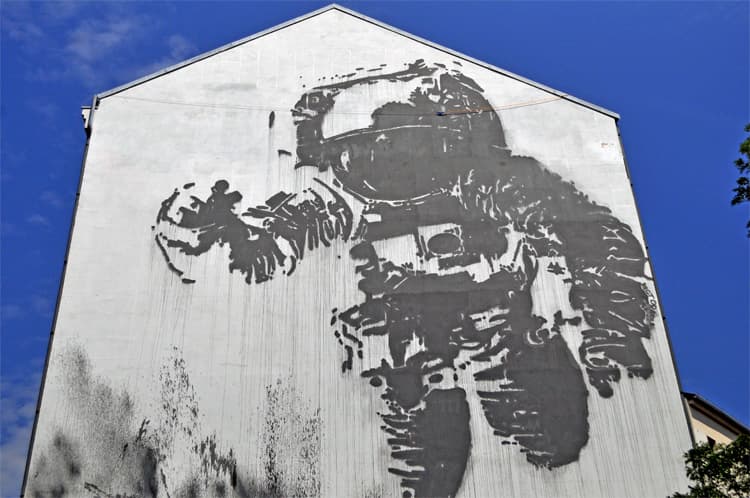
What do you think — stencil work? Think again. The artist manages to deceive viewers about his technique with remarkable ease. He uses spray cans but relies primarily on brushes, beginning with the outlines of his motif as a foundation. He sees street art as the medium that allows direct, immediate interaction with the public. Victor Ash considers his art democratic and wants as many people as possible to see his work. With the Astronaut, that goal has certainly been achieved — today it appears on countless Berlin postcards.
On the Trail of the Artist in Berlin
The purpose of his murals is above all to give passersby something to think about. In 2007, Victor Ash created a gigantic wall on Skalitzer Strasse in Kreuzberg — the “Astronaut/Cosmonaut,” painted for the Backjumps street art festival. The artist chose an astronaut as a reference to the space race, symbolizing the Cold War.
You can also spot one of his walls near the Wedding U-Bahn station, depicting three children sitting in the branches of a tree with binoculars pressed to their eyes, observing… what exactly is left up to the viewer.
In the summer of 2015, his work was featured at Backjumps at the Kunstraum/Bethanien in Kreuzberg, showing a man with a house for a head, standing on a gondola and playing electric guitar.
From the Street to the Gallery
In the gallery, he trades the wall for paper, glass, and canvas. He employs a multitude of techniques ranging from stencil to acrylic, spray paint, and screenprinting. He adapts his work to smaller surfaces while maintaining the same sharp commentary on society.